
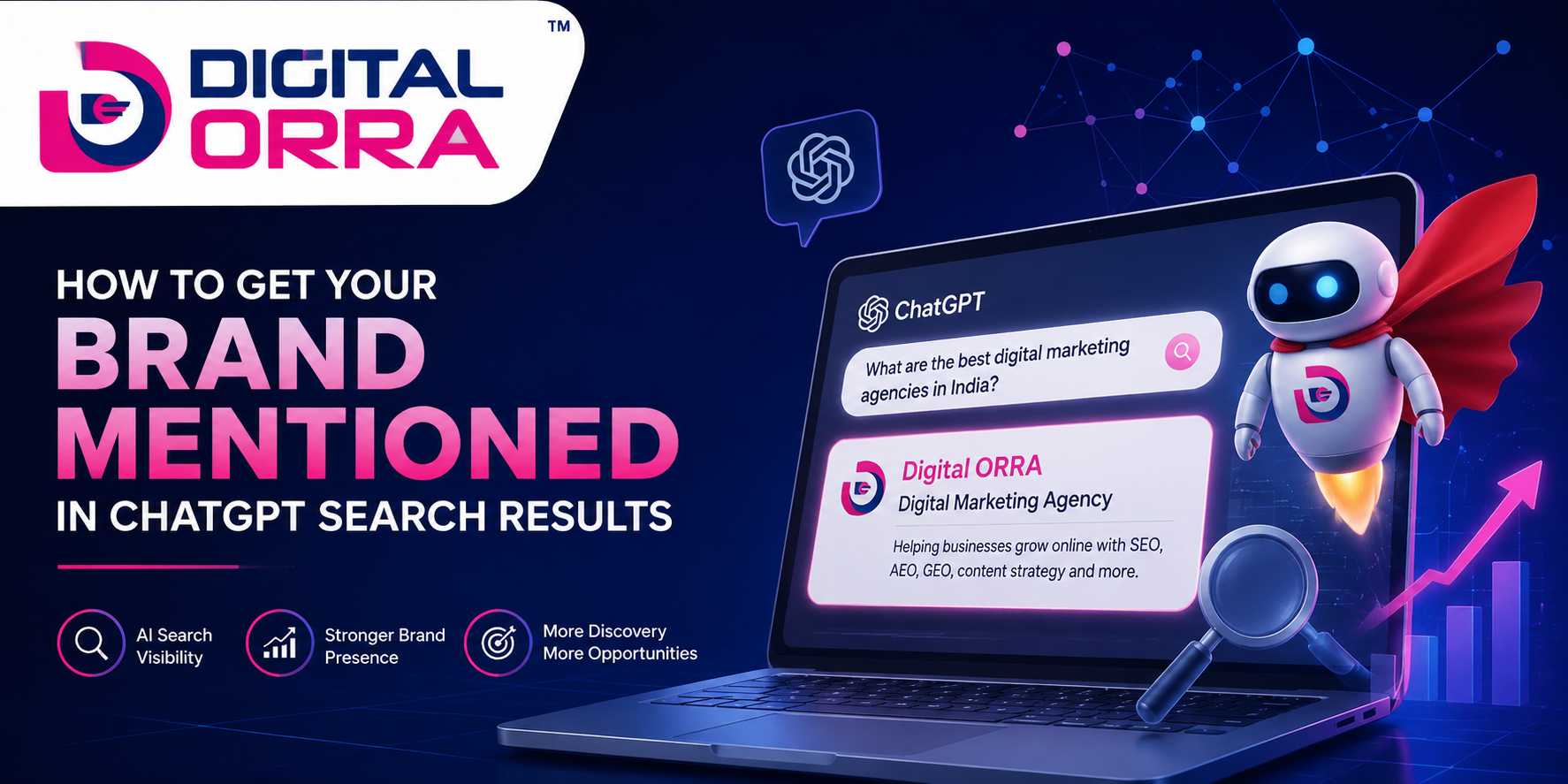
Learn how to improve your brand visibility in ChatGPT search results with GEO, AEO, SEO, topical authority, content, citations and AI search strategies.
Search is changing. People are no longer relying only on Google to discover businesses, products, services, and information. Increasingly, they are asking AI tools such as ChatGPT questions like:
“What are the best digital marketing agencies in India?”
“Which SEO companies can help a small business?”
“What are the best alternatives to Google Ads?”
“Which digital marketing agencies offer GEO services?”
When ChatGPT searches the web, its answers can include links to relevant websites and sources. This creates a new opportunity for businesses: getting their brand discovered and mentioned in AI-generated answers.
However, there is no guaranteed method to make ChatGPT mention a particular brand. ChatGPT search considers relevance and other signals, and OpenAI states that placement in search results is not guaranteed.
So, instead of thinking about “ranking #1 in ChatGPT,” businesses should focus on building strong AI search visibility.
What Does a Brand Mention in ChatGPT Mean?
A brand mention happens when an AI-generated response names your company while answering a user's question.
For example, if someone asks:
“What are some digital marketing agencies in India?”
and ChatGPT includes your company among the agencies it discusses, your brand has achieved an AI-search mention.
A mention and a citation are not the same thing. A citation means ChatGPT links to a source, while a mention means your brand name appears in the answer. Recent research has found that these two signals can behave differently, so businesses should track both rather than treating them as one metric.
Why Are ChatGPT Brand Mentions Important?
Traditional search visibility focuses heavily on where your website appears in search engine results.
AI search introduces another layer.
A potential customer might ask ChatGPT:
“How can I improve my website's SEO?”
Instead of scrolling through ten Google results, the user may receive a summarized answer containing several recommended tools, companies, websites, or resources.
If your brand is mentioned or cited, you have another opportunity to enter the customer's research journey.
This is particularly important for businesses operating in competitive categories such as:
Digital marketing
SEO
SaaS
Education
Finance
Healthcare
E-commerce
Professional services
Technology
1. Create Content Around the Topics Your Brand Wants to Own
One of the most important steps is building strong topical coverage.
If your company provides SEO services, don't publish only one article about SEO.
Create a connected content ecosystem covering topics such as:
What is SEO?
How does SEO work?
Technical SEO checklist
Local SEO strategies
SEO for small businesses
SEO vs Google Ads
SEO vs AEO
SEO vs GEO
How to perform a competitor SEO analysis
How long does SEO take?
This gives search engines and AI systems more information about your expertise.
Recent Semrush research also indicates that AI visibility can vary significantly from one prompt to another, and that consistent visibility across related questions is more meaningful than appearing for only one isolated prompt.
2. Build Topic Authority Instead of Writing Random Articles
Publishing hundreds of unrelated blogs isn't necessarily the best approach.
Instead, build topic clusters.
For example, Digital ORRA could create an AI-search cluster around:
AI Search Optimization
Supporting content could include:
What Is AEO?
What Is GEO?
What Is AIO?
AEO vs SEO
GEO vs SEO
AEO vs GEO
SEO vs AEO vs GEO
How to Optimize Content for AI Search
How to Increase Brand Visibility in AI Search
How AI Search Is Changing Digital Marketing
Each article can link naturally to the others and to the relevant service page.
This creates a stronger topical structure than publishing disconnected articles.
3. Make Your Website Easy for Search Crawlers to Discover
Technical accessibility matters.
OpenAI's documentation says websites can be eligible for inclusion in ChatGPT search and recommends allowing OAI-SearchBot to crawl relevant content. Website owners should also ensure their hosting environment or CDN allows traffic from OpenAI's published searchbot IP addresses.
Before focusing heavily on content, check:
robots.txt
noindex directives
canonical tags
XML sitemap
internal links
server accessibility
important pages' crawlability
structured data where appropriate
If important content cannot be discovered or crawled, it becomes harder for that content to be surfaced.
4. Write Clear, Direct Answers
AI systems need to understand what a page is actually about.
Avoid hiding the main answer under long introductions.
For example, instead of beginning an article with several paragraphs about the history of SEO, answer the question directly:
What is GEO?
GEO, or Generative Engine Optimization, is the practice of improving a brand's visibility in AI-generated search experiences by creating useful, authoritative and easily understandable information that AI systems can discover and use.
Then expand on the subject.
This structure also helps human readers because they can quickly understand the answer before exploring the details.
5. Create Question-Based Content
Think about how your customers actually ask questions.
Instead of targeting only:
Digital Marketing Agency
create content around questions such as:
How do I choose a digital marketing agency?
What does a digital marketing agency do?
How much does digital marketing cost in India?
Which digital marketing services does a business need?
How long does SEO take?
How can I increase organic traffic?
How can I optimize my website for AI search?
What is the difference between SEO and GEO?
Question-based content gives you more opportunities to address specific search intents.
6. Build Genuine Third-Party Brand Mentions
Your own website is only one part of your online presence.
Businesses should also build legitimate visibility across relevant third-party sources.
For example:
Industry publications
Business directories
Professional associations
News websites
Podcasts
YouTube
Interviews
Expert contributions
Relevant review platforms
Partner websites
The goal shouldn't be to create hundreds of low-quality backlinks.
Instead, focus on relevant and credible references to your brand.
Research from Ahrefs found a strong correlation between branded web mentions and AI visibility, while YouTube mentions showed an even stronger correlation in its analysis of 75,000 brands. Correlation does not prove that these factors directly cause AI visibility, but it does provide useful evidence about where brands can build broader visibility.
7. Don't Ignore YouTube
AI visibility isn't limited to traditional webpages.
Your brand can also build visibility through video content.
Create useful videos around your core topics:
SEO tutorials
Google Ads guides
Digital marketing tips
AEO tutorials
GEO strategies
Marketing case studies
SEO mistakes
Website audits
Industry trends
For Digital ORRA, for example, videos explaining “How GEO Works,” “AEO vs SEO,” or “How to Optimize a Website for AI Search” can support the same topical ecosystem as the company's blog content.
8. Create Original Data and Case Studies
AI systems have plenty of access to generic information.
Original information can make your brand's content more distinctive.
Consider publishing:
Case studies
Original surveys
Campaign results
Industry research
SEO experiments
Before-and-after analyses
Customer research
Original statistics
Expert interviews
For example, instead of publishing:
“SEO is important for businesses.”
create:
“What We Learned From Auditing 50 Small Business Websites”
Original research gives other websites something useful to reference and discuss.
9. Strengthen Your Brand's Entity Signals
Make sure your brand information is consistent across the web.
Your company name, website, services, location, social profiles and business descriptions should not contradict one another.
Check your:
About page
Contact page
Google Business Profile
LinkedIn
YouTube
Social media profiles
Business directories
Industry profiles
Author profiles
Also clearly explain what your company does and who it serves.
For example:
Digital ORRA is a digital marketing company offering SEO, AEO, GEO, Google Ads, Meta Ads, social media marketing, web development and other digital marketing services.
Clear entity information helps users and search systems understand the relationship between your brand and your areas of expertise.
10. Use Authoritative Authors and Expert Content
Content should demonstrate genuine expertise.
Where appropriate, include:
Author names
Professional biographies
Relevant experience
Editorial review
Sources
Original research
Expert opinions
Updated information
Don't create author profiles simply for SEO.
The goal is to make it clear who created the information and why that person or organization is qualified to discuss the subject.
11. Optimize for Multiple Related Prompts
One common mistake is testing ChatGPT with only one question.
Suppose you want Digital ORRA to appear for GEO services.
Don't test only:
“What is the best GEO company in India?”
Create a larger prompt set:
What is GEO?
What does a GEO agency do?
How can a business improve AI search visibility?
How does GEO differ from SEO?
What services does a GEO agency provide?
How can I optimize my website for ChatGPT?
Which companies provide GEO services in India?
How can brands increase AI search visibility?
Then record:
This gives you a much more useful picture of AI visibility.
Recent research supports this approach: brand visibility can change substantially between related prompts, so monitoring a topic rather than a single question provides a better picture of performance.
12. Keep Improving Your Traditional SEO
GEO does not mean abandoning SEO.
Your website still needs:
Crawlable pages
Useful content
Strong internal linking
Good page experience
Relevant backlinks
Clear site architecture
Search-intent alignment
Strong topical coverage
AI search can use web sources and citations, so making your website discoverable remains important. OpenAI specifically notes that ChatGPT search ranks results using multiple factors and that inclusion or placement is not guaranteed.
What Not to Do
Avoid shortcuts such as:
Creating hundreds of AI-generated pages with little original value
Keyword stuffing
Publishing fake reviews
Creating spammy directory profiles
Buying irrelevant backlinks
Creating fake expert profiles
Repeating your brand name unnaturally
Making unsupported claims about your business
AI visibility should be treated as an extension of your overall digital presence, not as a loophole around traditional search.
How to Measure ChatGPT Brand Visibility
Track more than website traffic.
Important metrics can include:
Brand Mention Rate
How often your brand appears when relevant prompts are tested.
Citation Rate
How often your website is linked as a source.
Share of AI Visibility
How frequently your brand appears compared with other brands across a defined prompt set.
Referral Traffic
Monitor traffic coming from ChatGPT and other AI platforms in your analytics.
Prompt Coverage
Track how many relevant questions produce a brand mention.
For example:
100 relevant prompts → 32 brand mentions → 18 website citations
You can compare this measurement month over month.
Remember that AI answers can vary between prompts and over time, so one successful result should not be treated as a permanent ranking position.
Final Thoughts
Getting your brand mentioned in ChatGPT search results isn't about finding one secret SEO trick.
It is about building a strong digital footprint around the subjects your business is genuinely qualified to discuss.
Focus on:
Technical accessibility + helpful content + topical authority + original information + third-party mentions + consistent brand information + ongoing measurement.
For businesses investing in digital marketing, this creates a broader strategy that goes beyond traditional Google rankings.
The goal is not simply to rank for one keyword.
The goal is to become a recognizable and useful source within your business category across the growing AI-search ecosystem.
Need Help Structuring Your Digital Marketing Strategy?
Our media buying specialists at Digital ORRA audit your unit economics and map out a custom ROAS growth blueprint for your business.
GET FREE MARKETING AUDIT