
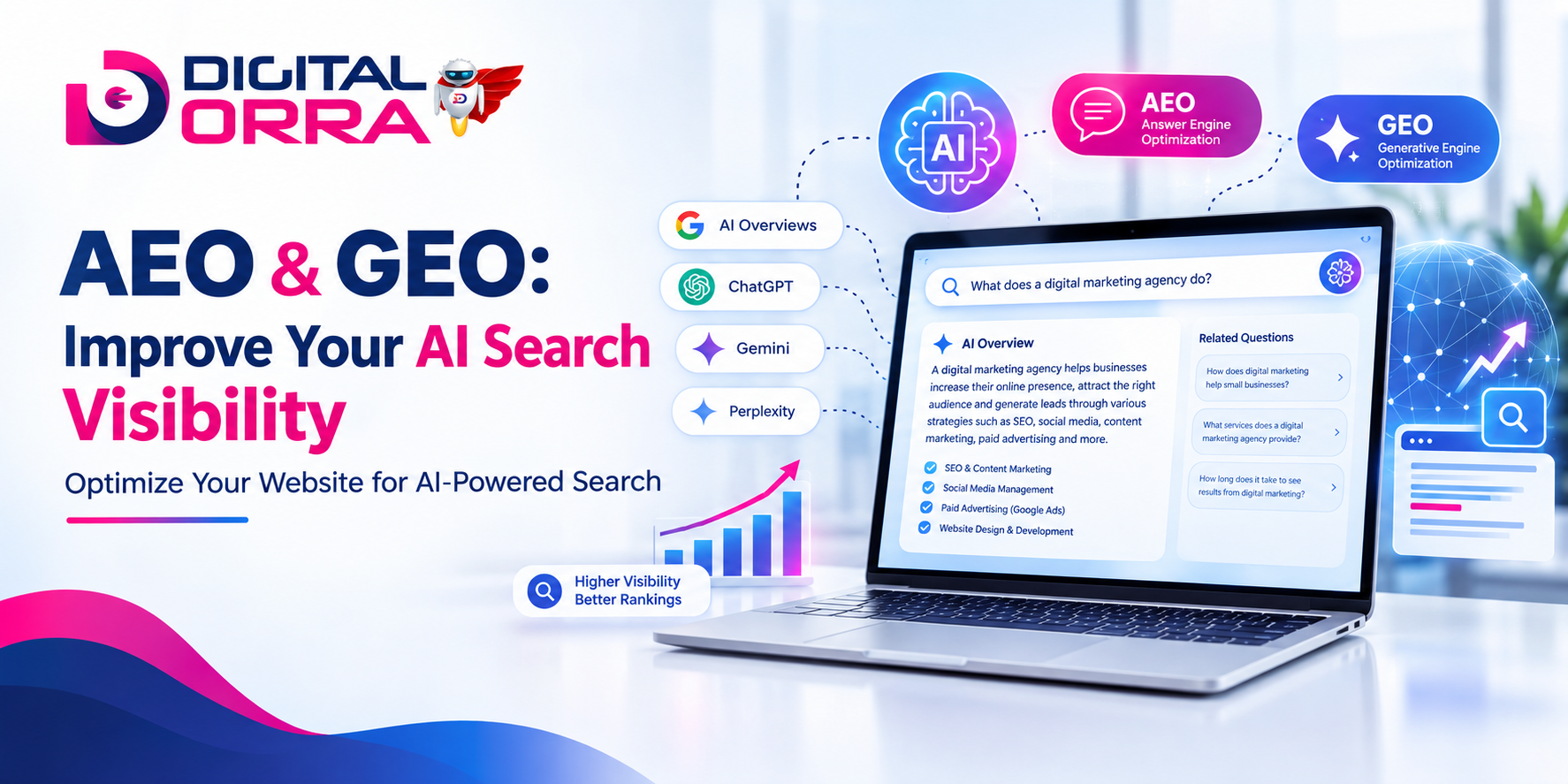
Learn how to implement AEO and GEO strategies to improve your website’s AI search visibility, content discoverability, and online presence.
Search is changing. People are no longer relying only on traditional Google search results to find information, products, services, and businesses. They are increasingly using AI-powered search experiences and tools to get direct, conversational answers.
This shift has made Answer Engine Optimization (AEO) and Generative Engine Optimization (GEO) important parts of a modern search strategy.
While traditional SEO focuses heavily on helping webpages rank in search results, AEO focuses on providing direct answers to users' questions, while GEO focuses on making content easier for AI systems to understand, use, and potentially reference in generated responses.
But how do you actually implement AEO and GEO on your website?
Let's look at the practical steps businesses can take to improve their website's visibility across traditional search and AI-powered search experiences.
What Are AEO and GEO?
Answer Engine Optimization (AEO) is the process of structuring and optimizing content so that search engines and answer-focused systems can easily identify and provide useful answers to users' questions.
For example, instead of targeting only the keyword "digital marketing agency," an AEO-focused page could directly answer:
"What services does a digital marketing agency provide?"
The answer should be clear, concise, and supported by useful information.
Generative Engine Optimization (GEO) focuses on optimizing content for generative AI search experiences. The goal is to make your website's information clear, relevant, trustworthy, and useful enough to potentially be considered when AI systems generate answers.
AEO and GEO are closely related, but they are not exactly the same. Both require a shift from simply targeting keywords to creating content that genuinely answers users' needs.
Why AEO and GEO Matter for Your Website
People increasingly search using complete questions and conversational phrases rather than short keywords.
For example:
"What is the best way to improve website visibility?"
"How does SEO help a small business?"
"What should I include on a service page?"
"How can a business appear in AI search results?"
This means websites need content that is easy to understand, well structured, and capable of answering specific questions.
A strong AEO and GEO strategy can help your website become more useful across different search experiences while also improving the overall quality and structure of your content.
How to Implement AEO and GEO for Your Website
1. Find the Questions Your Target Audience Is Asking
Start by identifying the actual questions your customers and potential customers ask.
Look beyond traditional keyword research and find informational, commercial, and conversational queries related to your products or services.
You can use:
Google Search suggestions
People Also Ask
Google Search Console
Keyword research tools
Customer questions
Sales and support conversations
Reddit and relevant online communities
Competitor FAQs
AI search queries
For example, if you provide SEO services, don't target only "SEO services." Also consider questions such as:
"How does SEO improve website traffic?"
"How long does SEO take to show results?"
"What does an SEO agency do?"
These questions can become the foundation of your AEO and GEO content strategy.
2. Create Clear and Direct Answers
One of the simplest ways to improve AEO is to answer questions directly.
Avoid making users read several paragraphs before reaching the answer.
For example:
Question: What is AEO?
Answer: AEO, or Answer Engine Optimization, is the process of optimizing website content so that search engines and answer-focused systems can easily understand and use it to respond to user questions.
You can then provide additional details below the direct answer.
This structure makes your content easier for both users and search systems to understand.
3. Optimize Your Existing Website Content
AEO and GEO should not be limited to new blog posts.
Review your existing:
Homepage
Service pages
Product pages
About page
Location pages
Blog posts
Case studies
FAQ pages
Look for important questions that your existing pages fail to answer.
For example, a digital marketing service page could answer:
What does digital marketing include?
Which businesses need digital marketing?
How does digital marketing work?
How long does digital marketing take?
What services does your agency provide?
How can businesses measure digital marketing results?
Adding useful answers can make an existing page more comprehensive without creating a separate page for every question.
4. Create Question-Based Content
Traditional blog titles often focus heavily on keywords.
Instead, create content around the questions your audience actually wants answered.
For example:
Traditional topic:
"SEO Services"
Question-based topics:
How Does SEO Help a Business Grow?
How Long Does SEO Take to Show Results?
What Should an SEO Strategy Include?
How Can Small Businesses Improve Their Search Visibility?
This approach naturally supports conversational searches and gives your website more opportunities to answer specific user needs.
5. Add FAQs to Important Pages
FAQ sections can be particularly useful for answering common questions related to your business, services, products, and industry.
For example, a web development page could include:
How long does it take to build a business website?
How much does website development cost?
Can you redesign an existing website?
Is a mobile-friendly website important for SEO?
The answers should be genuinely useful and specific to your business rather than generic content created only to target keywords.
6. Implement Relevant Schema Markup
Structured data helps search engines better understand the information contained on a webpage.
Depending on the page, relevant structured data can include types such as:
Organization
LocalBusiness
Article
BreadcrumbList
Product
Service
Event
Use structured data where it accurately represents the content on the page.
Schema markup should support your content, not be used as a shortcut for creating visibility.
7. Strengthen Internal Linking
Internal links help search engines understand the relationship between different pages on your website.
For example, a blog about "How to Improve Website SEO" could naturally link to your:
SEO service page
Technical SEO guide
Keyword research guide
Website audit service
Related case study
Use descriptive anchor text so users and search engines can understand what the linked page is about.
A well-connected website also makes it easier for users to discover related information.
8. Demonstrate Experience and Expertise
AI search systems need reliable information to generate useful answers, so the quality and credibility of your content matter.
Make your content more valuable by including:
Original research
Real examples
Case studies
Statistics with sources
Expert insights
Author information
First-hand experience
Clear business information
Instead of writing a generic article about SEO, for example, explain what your team has actually observed while working on SEO campaigns.
Original experiences can make content more useful than another generic article covering the same topic.
9. Build Brand Authority and Online Mentions
Your website is not the only place where your brand's information exists.
Your business may also be mentioned on:
Industry websites
Business directories
News websites
Review platforms
Partner websites
Professional communities
Social platforms
Maintain consistent information about your business, including your company name, services, locations, and other important details.
Relevant third-party references can also help establish context around your brand.
10. Keep Your Business Information Consistent
Make sure important business information is consistent across your website and other online profiles.
Check details such as:
Business name
Address
Phone number
Website
Services
Locations
Company description
Business categories
For local businesses, consistency is particularly important because users may discover the business through multiple search and AI-powered experiences.
11. Keep Your Content Updated
AI search optimization is not a one-time activity.
Industries change, statistics become outdated, services evolve, and search behavior changes.
Regularly review important pages and update:
Outdated statistics
Old examples
Broken links
Service information
Company details
Industry developments
Frequently asked questions
You can also expand existing content when you discover new questions from customers or Search Console data.
12. Test Your Website Across AI Search Experiences
One of the most practical ways to monitor GEO is to test how your brand appears when people ask relevant questions.
Create a list of questions related to your business.
For example:
"What are the best digital marketing services for small businesses?"
"How can a business improve its SEO?"
"Which services should a business use for online marketing?"
"How can I improve my website's visibility in search?"
Run these types of queries across relevant AI-powered search experiences and record:
Whether your brand appears
How your brand is described
Which pages or information are referenced
Whether competitors are mentioned
Whether the information about your business is accurate
This gives you a practical baseline for monitoring your AI search visibility over time.
How to Check Your AEO and GEO Performance
Traditional SEO metrics such as rankings, impressions, clicks, and organic traffic are still important.
However, AEO and GEO require additional monitoring.
You can track:
Traditional SEO
Organic traffic
Keyword rankings
Search impressions
Click-through rate
Conversions
AEO
Visibility for question-based searches
Featured answer opportunities
FAQ performance
Search queries generating impressions
GEO
Brand mentions in AI-generated answers
Accuracy of your brand information
Frequency of appearance for relevant questions
Which competitors are mentioned
Which website content is referenced
Because AI search systems can generate different responses depending on the query and context, GEO measurement should be treated as an ongoing monitoring process rather than a single ranking position.
Common AEO and GEO Mistakes to Avoid
Writing Only for Keywords
Don't create content simply because a keyword has search volume. Start with the user's actual information need.
Creating Generic AI-Generated Content
AI tools can help with research and content workflows, but simply publishing generic AI-written articles is unlikely to create strong differentiation.
Add original insights, examples, data, experience, and useful information.
Answering Questions Without Context
A short answer is useful, but important topics often require supporting explanations, examples, and evidence.
Creating Too Many Thin Pages
You don't need a separate page for every variation of a question.
Where appropriate, group related questions into comprehensive pages.
Ignoring Existing Content
Before creating dozens of new articles, review your existing pages. Some may only need better structure, clearer answers, internal links, or updated information.
Treating GEO as a Replacement for SEO
GEO and AEO should complement your broader SEO strategy.
Technical SEO, helpful content, website usability, internal linking, authority, and strong information architecture continue to matter.
AEO and GEO Optimization Checklist
Before publishing or updating a page, ask:
Does the page answer a clear user question?
Is the main answer easy to find?
Are the headings descriptive?
Does the content provide useful depth?
Are relevant FAQs included?
Is the information accurate and current?
Are internal links relevant?
Is appropriate structured data implemented?
Does the content demonstrate real expertise or experience?
Is the business information consistent?
Does the page provide something more useful than competing generic content?
Have you tested relevant questions in AI search experiences?
Conclusion
AEO and GEO are changing how businesses approach website content and search visibility. Instead of creating content only to rank for keywords, businesses should focus on making their information clear, useful, structured, trustworthy, and easy for both people and search systems to understand.
The implementation starts with understanding your audience's questions, improving existing website pages, creating useful question-based content, strengthening internal linking, using appropriate structured data, demonstrating real expertise, and regularly testing how your brand appears in AI-powered search experiences.
A strong AEO and GEO strategy does not replace SEO. It builds on the fundamentals of good SEO while preparing your website for a search environment where users increasingly expect direct, conversational, and AI-generated answers.
Need Help Structuring Your Digital Marketing Strategy?
Our media buying specialists at Digital ORRA audit your unit economics and map out a custom ROAS growth blueprint for your business.
GET FREE MARKETING AUDIT